
Thursday, January 3, 2008

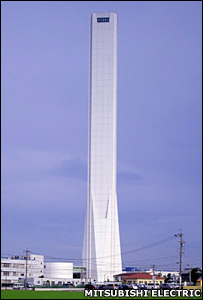
Mitsubishi's elevator-testing tower
The 173m-high (567ft) structure is called Solae and dominates the skyline of Inazawa City...
The 5bn-yen ($50m;£25m) project will allow Mitsubishi to test new drives, gears, cables and other lift systems.
Link
(Thanks, Geoff!)
source
UK mall bans grandparents for trying to photo their grandkids
Malls get all kinds of tax- and zoning-deals in order to set up shop in the middle of town, often displacing public streets and squares. Then their owners turn into ban-happy authoritarians who set out all kinds of ridiculous policies and repeat an endless mantra of "private property" without ever acknowledging the public largesse on which they depend.
The couple were on a four-day break from their home in Spain and wanted to surprise their family by arriving at the centre, in Fareham, Hants, while they were shopping.
But when they went to take a photo, a security guard pounced and ordered them out.
The guard then insisted that cameras were banned because of the risk of a terrorist attack - and barred the bemused couple for life.
Speaking from her home in Malaga, Spain, Mrs Sparshott, 51, said: "I couldn't believe it. I was so shocked.
"He said we had committed an act of terrorism.
"At first I wanted the ground to swallow me up whole because it was so embarassing - but then I got really angry."

When I was in high-school, the Intercon security staff for College Park in Toronto -- the mall across the road -- banned more than half the student body and many of the faculty, for arbitrary and imaginary reasons. I remember one day I was in the line to buy my lunch when a security guard came up and issued me a lifetime ban "for hanging around, not buying anything." The irony of my having to interrupt him to collect my change and receipt was apparently lost on him (and the mall management, who wouldn't return my call).
These behemoths take our handouts and take over our streets -- the least they can do is behave like good neighbors.
Link
(Image: Thumbnail of a photo copyright Solent News)
source
Scientific American's Year in Robots
LinkThis sampling merely scratches the surface of the past year's advances in robotics that whet the appetite for what's to come: Early next year, for instance, researchers at the University of Colorado at Boulder will benchmark robotic devices to precisely mix and measure medications used in treatments such as chemotherapy. The robotic Mars rovers Opportunity and Spirit are currently hunkering down in anticipation of the harsh Martian winter season but will soon resume their exploration of the Red Planet. And Scandanavian research firm Sintef is developing artificially intelligent equipment to help offshore oil and gas drilling platforms run more safely and efficiently.
source
Harvard's robotic fly takes off

Last summer, I posted that the first microrobotic fly had actually flown. Built by Harvard University professor Robert Wood and his colleagues, with funds from the US military ('natch), the 60 milligram robofly boasts a three centimeter wingspan. Its wing motions are based on those of a real fly. The robotic fly project was first, er, launched at Berkeley a decade ago. I'm delighted that I have one of the early resin fly models from that phase in my cabinet of curiosities. The new issue of Harvard Magazine profiles Wood and features the video of the fly at lift off. From the article:
Wood figures he is still only one-third of the way toward his goal of creating an autonomous flying robot. But the next step should be at least as rewarding, considering that it will include a focus on control of the insect—the reason he first got involved in the project years ago. His fly now runs on electricity transmitted via thin wiring from high-voltage amplifiers, but he aims to add an on-board power source. Initially, he hopes for five minutes of flying time, which will be extended as the battery options improve.
Eventually, he hopes to program insect robots to work in a group. “We want a human operator to be able to take out his batch of flies and say, ‘I want you guys to search for carbon dioxide’—a survivor breathing in a collapsed building,” he explains. From there, Wood sees the possibility of building group behaviors into a swarm: a means of pursuing his interest in the study of emergence, which examines how simple organisms such as ants can produce complex group structures.
Link (Thanks, Paul Saffo!)
Previously on BB:
• Robofly takes off Link
• UC Berkeley's micro-mechanical flying insect Link
source

