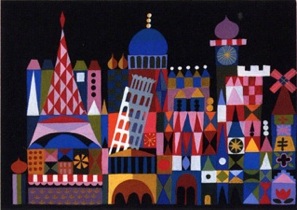
Howard Rheingold is scanning and posting the awe-inspiring pages from his notebook with sketches and notes for the design of HotWired, Wired's groundbreaking (and defunct) website. I love his use of color.
Link
source


"Reclaim your mind from the media's shackles. Read a book and resurect [sic] yourself. To claim your capitalistic garbage go to your nearest Apple store."
Jay Ellis, the girls father, returned the iPod to the Germantown, Md. Wal-Mart store where he purchased it. The store manger told him that another customer returned an iPod with a similar issue.
The liquid does not need to be boiling - the spoon will also bend if placed under the hot tap.To reset the spoon, just cool it under the cold tap, and straighten it again. The spoon can be used many times, as Nitinol is a very flexible metal.
(*If you can find a link to the video of Geller on the Tonight Show, please post it in the comments section)
Link
"What shall the prophylaxis (prevention) and therapy (treatment) be? How can the effects of this force be mitigated? Lying down relieves the daytime direction of fatiguing pull in the case of the well or slightly ill; but something more than this is needed by the badly-damaged. We suggest periods of centrifugalization. An individual in special need of treatment might rest at night upon a large revolving disc with his head toward the outer rim; the disc should be so beveled as to carry the head at a lower level than the feet; optimum (best) speed to be determined by laboratory experimentation. Such a disc might be large enough to carry ten or twenty patients. This mechanism would facilitate the functions which during the day are inhibited by gravity. Incidentally, certain cardiac (heart) and vascular disabilities might be especially helped. The decompensated heart, with edematous (swollen) and varicose extremities, might respond well."

It's pretty dismal. Basically, no country in the world presents a healthy environment for people who care about their privacy.
Link
(Thanks, Sam!)
Giants like Yahoo and Google have thus far taken a mostly nonproprietary stance toward their data, typically letting outside developers access it in an attempt to curry favor with them and foster increased inbound Web traffic. Most of the largest Web companies position themselves as benign, bountiful data gardens, supplying the environment and raw materials to build inspired new products. After all, Google itself, that harbinger of the Web2.0 era, thrives on info that could be said to "belong" to others -- the links, keywords, and metadata that reside on other Web sites and that Google harvests and repositions into search results.
But beneath all the kumbayas, there's an awkward dance going on, an unregulated give-and-take of information for which the rules are still being worked out. And in many cases, some of the big guys that have been the source of that data are finding they can't -- or simply don't want to -- allow everyone to access their information, Web2.0 dogma be damned. The result: a generation of businesses that depend upon the continued good graces of a relatively small group of Internet powerhouses that philosophically agree information should be free -- until suddenly it isn't.

The episode parodies many, many science fiction classics (and the host sports a nifty DMZ tee from The Secret Headquarters!) and does a good job of laying out the basic issues in funny, easy-to-understand ways.
It's a cinch that Minister Prentice will reintroduce the Canadian DMCA in 2008 -- and we're gonna kill it again!
Link
(via Michael Geist)
A 29-year-old Wenatchee man told police a pterodactyl caused him to drive his car into a light pole about 11:30 p.m. Thursday.When police asked the man what caused the accident, his one-word answer was "pterodactyl," Smith said. A pterodactyl was a giant winged reptile that lived more than 65 million years ago.
Previously on Boing Boing:
• Leprechaun opens car door for pantless man
Link
By tumbling a string of rope inside a box, biophysicists Dorian Raymer and Douglas Smith have discovered that knots—even complex knots—form surprisingly fast and often. The string first coils up, and then its free ends swivel around the other coils, tracing a random path among them. That essentially makes the coils into a braid, producing knots, the scientists say...
In topology, a knot is any curved line that closes up on itself, possibly after a circuitous path in three dimensions. A circle is regarded as the "trivial" knot. Two loops are considered to be the same knot if you can turn one into the other by topological manipulation, which in this case means anything that does not break the curve or force it to run through itself.
Topologically, a knotted string is not a real knot, as long as its ends are free. That's because either of the ends can always thread back through any entanglement and undo the knot. An open string, no matter how garbled, is the same as a straight segment. (Mathematicians usually think of strings as being stretchable and infinitesimally thin, so in topology there is no issue of a knot being tight.)
Strictly speaking, then, the string in Raymer and Smith's box was never knotted. But it was still a mess.

Sir Ken Macdonald said terrorist fanatics were not soldiers fighting a war but simply members of an aimless "death cult."The Director of Public Prosecutions said: 'We resist the language of warfare, and I think the government has moved on this. It no longer uses this sort of language."
London is not a battlefield, he said.
"The people who were murdered on July 7 were not the victims of war. The men who killed them were not soldiers," Macdonald said. "They were fantasists, narcissists, murderers and criminals and need to be responded to in that way."
One of the hot Christmas items this year was Moon Sand. But while it's certainly not a bank-breaker, it is costly for what is basically wet sand. So, I did a little digging around (pun intended) and discovered a way to make your very own moon sand. Here's the best part...the homemade stuff will set you back less than 60 cents per pound!
As you may know, there are several Moon Sand kits out there, and they come with all sorts of the usual play-dough style gadgets and molds. But if you just want a bucket of the stuff, the best deal I have found so far is at Amazon, where a 7 1/2 lb tub will cost you $18.74, down from $29.99 (at the time this article was published).