Thursday, January 3, 2008

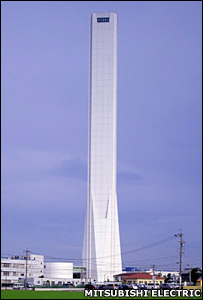
Mitsubishi's elevator-testing tower
The 173m-high (567ft) structure is called Solae and dominates the skyline of Inazawa City...
The 5bn-yen ($50m;£25m) project will allow Mitsubishi to test new drives, gears, cables and other lift systems.
Link
(Thanks, Geoff!)
source
UK mall bans grandparents for trying to photo their grandkids
Malls get all kinds of tax- and zoning-deals in order to set up shop in the middle of town, often displacing public streets and squares. Then their owners turn into ban-happy authoritarians who set out all kinds of ridiculous policies and repeat an endless mantra of "private property" without ever acknowledging the public largesse on which they depend.
The couple were on a four-day break from their home in Spain and wanted to surprise their family by arriving at the centre, in Fareham, Hants, while they were shopping.
But when they went to take a photo, a security guard pounced and ordered them out.
The guard then insisted that cameras were banned because of the risk of a terrorist attack - and barred the bemused couple for life.
Speaking from her home in Malaga, Spain, Mrs Sparshott, 51, said: "I couldn't believe it. I was so shocked.
"He said we had committed an act of terrorism.
"At first I wanted the ground to swallow me up whole because it was so embarassing - but then I got really angry."

When I was in high-school, the Intercon security staff for College Park in Toronto -- the mall across the road -- banned more than half the student body and many of the faculty, for arbitrary and imaginary reasons. I remember one day I was in the line to buy my lunch when a security guard came up and issued me a lifetime ban "for hanging around, not buying anything." The irony of my having to interrupt him to collect my change and receipt was apparently lost on him (and the mall management, who wouldn't return my call).
These behemoths take our handouts and take over our streets -- the least they can do is behave like good neighbors.
Link
(Image: Thumbnail of a photo copyright Solent News)
source
Scientific American's Year in Robots
LinkThis sampling merely scratches the surface of the past year's advances in robotics that whet the appetite for what's to come: Early next year, for instance, researchers at the University of Colorado at Boulder will benchmark robotic devices to precisely mix and measure medications used in treatments such as chemotherapy. The robotic Mars rovers Opportunity and Spirit are currently hunkering down in anticipation of the harsh Martian winter season but will soon resume their exploration of the Red Planet. And Scandanavian research firm Sintef is developing artificially intelligent equipment to help offshore oil and gas drilling platforms run more safely and efficiently.
source
Harvard's robotic fly takes off

Last summer, I posted that the first microrobotic fly had actually flown. Built by Harvard University professor Robert Wood and his colleagues, with funds from the US military ('natch), the 60 milligram robofly boasts a three centimeter wingspan. Its wing motions are based on those of a real fly. The robotic fly project was first, er, launched at Berkeley a decade ago. I'm delighted that I have one of the early resin fly models from that phase in my cabinet of curiosities. The new issue of Harvard Magazine profiles Wood and features the video of the fly at lift off. From the article:
Wood figures he is still only one-third of the way toward his goal of creating an autonomous flying robot. But the next step should be at least as rewarding, considering that it will include a focus on control of the insect—the reason he first got involved in the project years ago. His fly now runs on electricity transmitted via thin wiring from high-voltage amplifiers, but he aims to add an on-board power source. Initially, he hopes for five minutes of flying time, which will be extended as the battery options improve.
Eventually, he hopes to program insect robots to work in a group. “We want a human operator to be able to take out his batch of flies and say, ‘I want you guys to search for carbon dioxide’—a survivor breathing in a collapsed building,” he explains. From there, Wood sees the possibility of building group behaviors into a swarm: a means of pursuing his interest in the study of emergence, which examines how simple organisms such as ants can produce complex group structures.
Link (Thanks, Paul Saffo!)
Previously on BB:
• Robofly takes off Link
• UC Berkeley's micro-mechanical flying insect Link
source
Kirsten Anderson's new art blog

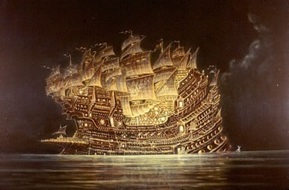
BB pal Kirsten Anderson is the author of one of my favorite art books of the last decade, Pop Surrealism: The Rise of Underground Art, and proprietor of Seattle's Roq La Rue Gallery. Kirsten just started a new art blog, Right Some Good, that already has turned me on to several incredible painters I wasn't familiar with. At left is a piece by Spanish artist Victor Castillo. At right, a ghost ship by Jacques Moiteret of Seattle. Link
source
Virgin Mary on living room wall
Link (via Peculiarosities)
Quintana said her husband was putting a special texture on the wall. The spray bottle he was using broke twice, which meant the texture couldn't be wiped off fast enough. This is how it dried.
"I feel like it's telling us something, like it's protecting us," Quintana said. "It's like a miracle."

source
Working wooden digger toy
The best addition to the sandpit you’ll ever see. The children were all desperate to have a go and it was fascinating to see how quickly and intuitively they grasped the concept behind the twin lever action. In no time at all sand was being meticulously moved from one corner of the sandpit to the other and back again. Needs a cover if to be kept outside permanently. Length 115.cm.

Link
(via Babygadget)
source
BBTV: Bar code artist Scott Blake / Falco stencil memorial
Boing Boing tv episode:
Austrian tech-art-pranksters Monochrom introduce us to Scott Blake, renowned bar code artist. We then observe Scott wandering the streets of Vienna collecting bar codes to properly memorialize the late Austrian pop star, Falco. He's a very big deal over there.
See also: Monochrom's Human USB Hack
Link to BBtv video and comments.
source
Copyright liner-notes for the future
Netflix and HD: a DRM disaster that costs you your videos and control of your hardware
I recently purchased a new HD monitor, but when I installed it, I lost the streaming capabilities on Netflix's website. When I tried to troubleshoot the issue, I had to agree to let Netflix "reset my DRM" by destroying my Amazon.com files. After talking with Netflix's technical support, I learned that the real issue had to do with the HD capabilities of my PC setup. Because Hollywood wants to punish people for using technology that is outside of their protocol, they are denying me access to low resolution internet videos until I downgrade my monitor to standard definition.
As if DRM isn't evil enough already, I now have to give up access to files I've already bought and even then might not be allowed access unless I have specific approved HD equipment that allows Hollywood to control how I consume my media content. I understand that content owners want to be able to charge for their content, but something is wrong when their DRM won't even allow you to pay to use their product.
Link
(Thanks, Davis!)
source
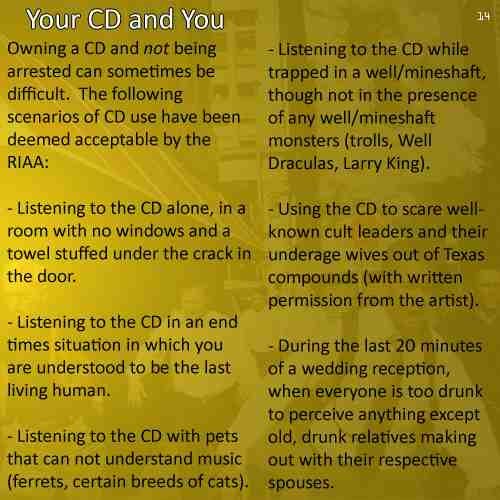
Motley Fool: litigation isn't a business model, sell RIAA short
As I've said before, a good sign of a dying industry that investors might want to avoid is when it would rather litigate than innovate, signaling a potential destroyer of value. If it starts to pursue paying customers -- which doesn't seem that outlandish at this point -- then I guess we'll all know the extent of the desperation. Investor, beware.
Link
(Thanks, Gary!)
source
Fight menus-under-doors with DANGER stickers
Menu littering is a huge problem in New York City. The increasingly competitive takeout and delivery industry hires their delivery guys during off hours to foist menus under the doors of apartment dwellers. It is now routine to come home to a pile of duplicate menus on my door mat -- not only annoying but a total waste of paper. Moreover, buildings routinely get fined by the city's department of sanitation if the menus are left near the front door of the building.
After a failed attempt by City Council member Simcha Felder to pass legislation banning the practice and suggesting a $50 fine, I've decided to start promoting my own solution: a simple bumper sticker that uses a helpful diagram to warn trespassers that fingers will be crushed if menus are put under the door. This has actually made a huge difference in reducing the number of menus arriving at my house.

Link
(Thanks, Fred!)
source
Gallery of beautiful vintage travel posters

Hamish sez, "A few years ago I found a collection of over 200 35mm Kodachrome slides of travel and marketing posters from the 1950's and 1960's. I received a nice Epson scanner for Christmas so I dug them up and scanned them all in. If only the travel posters of today were so stylish and exotic! "
Link
(Thanks, Hamish!)
source
Running Mosaic 0.9b on the modern Web
Moreover, NS 0.9b is like many early browsers in that it doesn't send a "Host: ..." header (lacking in HTTP 1.0, but now mandatory in HTTP 1.1), so that makes accessing most current web sites even harder. So I can't access Amazon, Google, or Wikipedia. IMDB pages actually load, if you hit Stop at strategic times. Still, the crashing; and also inexplicable DNS failures and network hangs.
Between the Host problem and the Content-Type problem, I can't even look at enough web pages such that I could make this NS 0.9b crash as much as I remember it being prone to. Or maybe it's just that Wine is more forgiving of wonky system calls that MSWindows 3.11 and/or Winsock were.

Link
(via JWZ)
source
RideAccidents: roundup site for carny ride accidents
Air Glory ride cited for 25 code violations; report suggests operator, not deficiences, to blame for death
Owner: operator "had a tendency not to lock the carabiner after attaching the rider to the ride."
(Friday, July 27, 2007) - The Air Glory freefall ride from which a girl fell to her death in Wisconsin on July 14 has been cited for 25 code violations by investigators who inspected the ride after the accident. Officials from the Wisconsin Commerce Department do not believe that the deficiencies contributed to the girl's death because the ride was operating properly at the time she was killed. However, one official said that the ride might have been red-tagged if the violations had been discovered before the accident. The ride was due for an inspection three days after the accident.
Link
(via Neatorama)
source
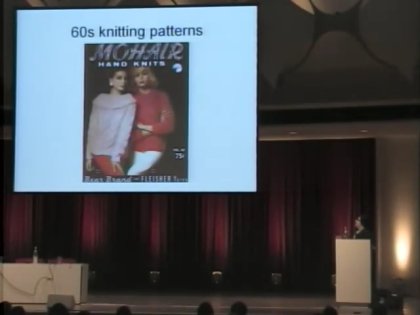
History of guerrilla knitting at 24th Chaos Communication Congress
"Guerrilla knitting" has a couple of meanings in the knitting community - to some, it merely means knitting in public, while to others, it means creating public art by knitted means.
Contemporary knitters feel very clever for coming up with edgy language to describe their knitting, but the truth is that for decades there have been knitters and other textile artists who are at least as punk rock as today's needle-wielders. This talk will cover the vibrant history of contemporary knitting, with a focus on projects that will make you say, "Wow, that's knitted?" Feel free to bring knitting projects to the talk - let's get some public knitting going on at the conference!
Link, Video download
(via Craft)
source